






Some links in this article are affiliate links. Automated Wealth Lab may earn a commission at no extra cost to you. See our Affiliate Disclosure.
- The four frameworks at a glance
- LangGraph: the state machine for serious workflows
- CrewAI: role-based crews, fastest path for Python teams
- AutoGen: powerful, influential — and in maintenance mode
- Flowise: the visual builder for people who don’t want a framework
- Hosting and observability: the real running costs
- Decision table: match the framework to the job
- FAQ
- Methodology
- AWL verdict
- Sources
Disclosure: This article contains an affiliate link for DigitalOcean. If you sign up through it we may earn a commission at no extra cost to you. LangGraph, CrewAI, AutoGen, Flowise and Microsoft pay us nothing. One status fact in this comparison changes buying decisions, so we flag it early: Microsoft put AutoGen into maintenance mode in October 2025 — details and the successor framework are covered in its section below.
Every business owner who wants “AI agents” eventually hits the same fork: four open-source frameworks dominate the conversation, they all demo beautifully, and they are built on four genuinely different ideas about how agents should work. LangGraph thinks in state machines. CrewAI thinks in job roles. AutoGen thinks in conversations. Flowise thinks in flowcharts. Picking the wrong one rarely fails loudly — it fails slowly, three months in, when you discover the thing your use case needs most (an approval step, a resumable long task, a non-technical teammate) is the thing your framework treats as an afterthought.
This comparison covers what each framework is, its license and language, how it handles state and memory, how humans stay in the loop, what observability costs, and what hosting actually looks like in production — with versions and project status checked against official sources in October 2026. It is written for business use: automations that touch customers, money or content pipelines, where “it worked in the demo” is not the bar.
The short answer: For production business workflows that need approvals, pauses and audit trails, LangGraph is the safest default — MIT-licensed, Python and TypeScript, with checkpointing and human-in-the-loop as core features; budget $39/seat/month for LangSmith if you want real observability. CrewAI is fastest for role-based content and research pipelines in Python. Flowise is the pick for non-developers — visual, self-hostable for free, cloud from $35/month. And AutoGen, while still installable, is in maintenance mode since October 2025; Microsoft’s successor, Agent Framework, reached 1.0 in April 2026 — new Microsoft-stack projects should start there instead.
The four frameworks at a glance
| LangGraph | CrewAI | AutoGen | Flowise | |
|---|---|---|---|---|
| Built by | LangChain Inc. | CrewAI Inc. (independent) | Microsoft | FlowiseAI |
| License | MIT | MIT | MIT | Apache 2.0 |
| Language | Python + JS/TS | Python only (3.10–3.13) | Python | TypeScript/Node, visual UI |
| Core model | Graph of nodes over shared state | Role-based agent “crews” + event-driven Flows | Multi-agent conversation / group chat | Drag-and-drop flows on a canvas |
| State & memory | Typed state + checkpointing every step; long-term memory store | Crew memory (short/long-term, entity); Flows state | Team state save/load; conversation history | Chat memory nodes, flow variables |
| Human-in-the-loop | First-class: interrupts, pause/resume | Task human-input flags, review steps | UserProxyAgent input modes | Approval steps in Agentflow (basic) |
| Observability | LangSmith (paid tiers for teams) | CrewAI AMP platform | OpenTelemetry hooks; DIY mostly | Built-in execution logs |
| Hosted option | LangSmith Deployment | CrewAI AMP | Azure via successor framework | Flowise Cloud $35–65/mo |
| Status, Oct 2026 | 1.x line, actively developed (1.0 GA Oct 2025) | 1.x line, actively developed (1.0 GA Oct 2025) | Maintenance mode (Oct 2025) | Active; acquired by Workday |
LangGraph: the state machine for serious workflows
LangGraph models your process as a graph: nodes are steps (an LLM call, a tool, a function), edges are the allowed transitions, and everything reads and writes a single typed state object. That sounds academic until you run a workflow that takes 40 minutes, hits an API outage at step 12, and needs to resume rather than restart — LangGraph checkpoints state after every node, so execution is durable, pausable and resumable. Checkpoints also enable “time travel” debugging: rewind to a previous state and replay forward with a change.
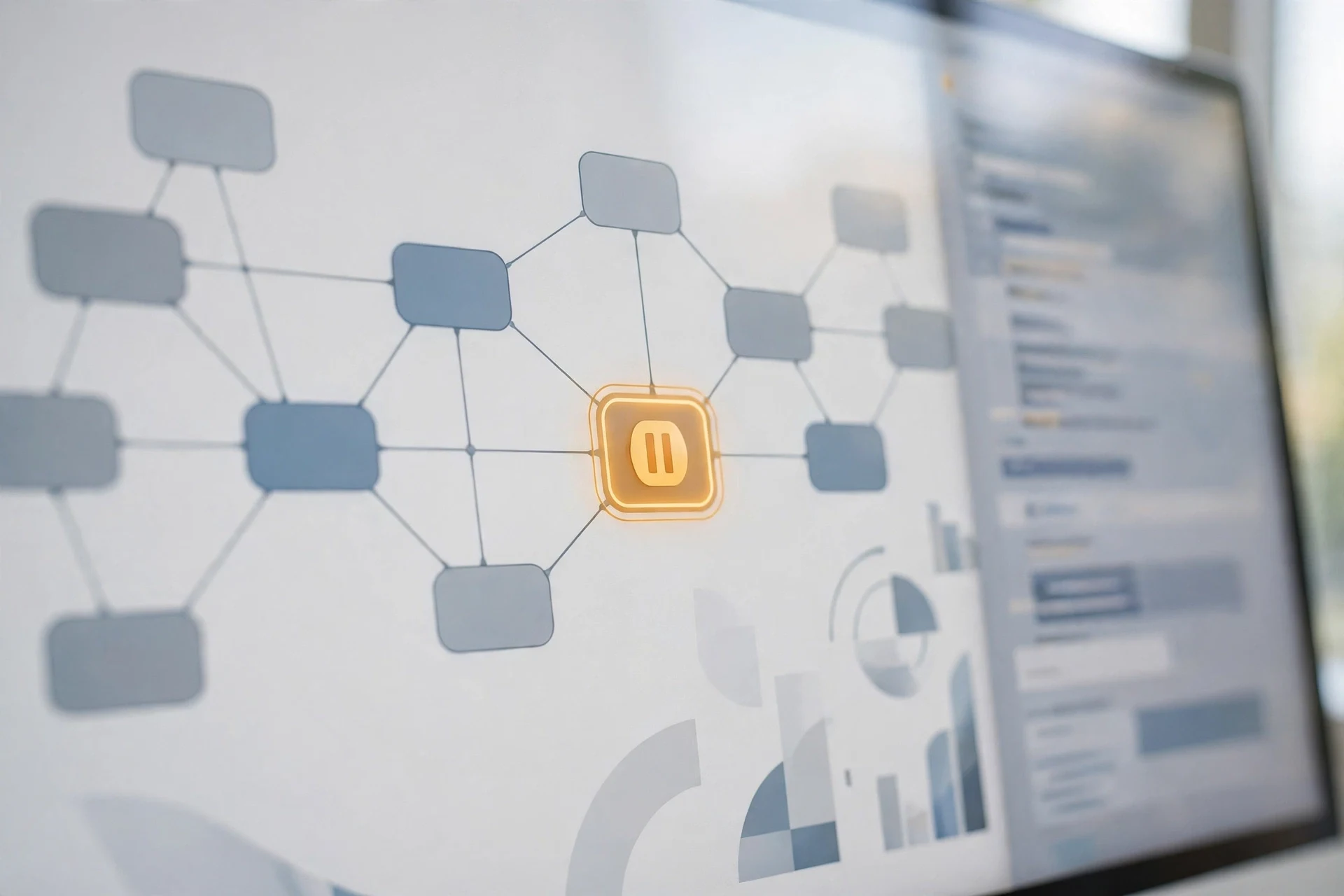
Its human-in-the-loop support is the strongest of the four. An interrupt call pauses the graph mid-run, persists everything, and waits — for minutes or days — until a human approves, edits the state, or rejects, then resumes exactly where it stopped. For business processes like “agent drafts the refund, human approves anything over $100,” this is the difference between a feature and a month of custom plumbing.
Memory comes in two layers: short-term memory is the thread’s checkpointed state; long-term memory is a separate store your nodes can read and write across conversations. The trade-offs are real, though. LangGraph is a low-level framework — you design the graph, the state schema and the error handling yourself. Budget developer time accordingly. And while the library is free and MIT-licensed, the surrounding platform is where LangChain makes money: LangSmith’s Developer tier is free (5,000 traces/month, one seat), Plus runs $39 per seat/month with 10,000 base traces and a free starter deployment, and only the custom-priced Enterprise tier offers self-hosted deployment of the managed runtime. The framework itself self-hosts anywhere Python or Node runs — the $39 buys you tracing, evaluation and one-click deployments, not permission to run.
Fits: long-running, stateful business processes with approvals — support escalation, research pipelines, document processing, ops automation. Doesn’t fit: non-technical builders, or simple one-shot agent tasks that don’t need durability.
CrewAI: role-based crews, fastest path for Python teams
CrewAI’s mental model is an org chart. You define agents with a role, a goal and a backstory (“Senior Researcher,” “Editor”), give them tasks with expected outputs, and a Crew runs them in a sequential or manager-led hierarchical process. For content pipelines, market research, lead enrichment and report generation — work that naturally decomposes into researcher/writer/reviewer — this maps so directly onto the task that a working multi-agent pipeline can be an afternoon’s work in plain Python.



Since its 1.0 release, CrewAI has had two halves. Crews are the role-based teams above; they run once to completion and their memory (built-in short-term, long-term and entity memory) belongs to that crew — it does not automatically federate across separate crews, a known limitation to design around. Flows are the deterministic half: event-driven orchestration with @start, @listen and @router decorators, conditional branching, loops and persisted state, where crews or single LLM calls plug in as steps. Serious business use usually ends up Flow-first with crews inside, because Flows give you the control that pure crew autonomy lacks.
Human-in-the-loop exists at task level (human input and review steps) and in the hosted platform’s guardrails, but it is less granular than LangGraph’s interrupt-anywhere model — approvals are steps you design in, not a primitive available at every node. CrewAI is MIT-licensed and standalone (not a LangChain layer, despite frequent claims otherwise). Its hosted platform, CrewAI AMP, adds managed deployment, traces and team controls: there’s a free tier (around 50 workflow executions a month — fine for trials), while the tiers with VPC deployment, SSO/RBAC and compliance features are custom-priced Enterprise. Note for non-Python shops: CrewAI is Python only.
Fits: Python teams building content, research and analysis pipelines; founders who think in job roles. Doesn’t fit: JavaScript stacks, or workflows needing pause-for-days approval semantics at arbitrary steps.
AutoGen: powerful, influential — and in maintenance mode
AutoGen pioneered the multi-agent conversation pattern: agents talk to each other in a group chat — taking turns round-robin, chosen by a selector model, or coordinated by a manager team (its Magentic-One pattern) — and converge on an answer. Its AgentChat layer sits on an event-driven Core, it handles code execution in sandboxed environments well, and human input is built in through UserProxyAgent modes (always ask, ask on termination, never ask). For research-style tasks — code generation with critique loops, multi-perspective analysis — it remains genuinely capable, and a large body of tutorials and examples exists.
Now the status you must plan around. On 2 October 2025, Microsoft placed AutoGen in maintenance mode: the project’s README banner states it “will not receive new features or enhancements and is community managed going forward.” Security and bug fixes continue, and the current 0.x releases still install and run — but the roadmap has ended. The reason is its successor: Microsoft Agent Framework, announced 1 October 2025 as the merger of AutoGen’s agent model with Semantic Kernel’s enterprise foundations, reached 1.0 GA on 3 April 2026. It is MIT-licensed, supports Python and .NET (Go in preview), and adds the production machinery AutoGen lacked: graph-based workflows, session state and checkpointing, human-approval steps, OpenTelemetry observability, MCP and A2A protocol support, and a hosted path through Azure AI Foundry.
One confusion to avoid: AG2 is a separate community fork of the original AutoGen by its early creators. It is actively developed, but it is not Microsoft’s successor — if you want the Microsoft-supported line, that’s Agent Framework.
Fits: existing AutoGen codebases worth keeping alive; prototypes and research where its conversation patterns shine; Microsoft/.NET shops — via Agent Framework 1.0 for anything new. Doesn’t fit: greenfield projects on AutoGen itself. Starting a new production system on a maintenance-mode framework in 2026 is technical debt chosen on purpose.
Flowise: the visual builder for people who don’t want a framework
Flowise takes the opposite bet from LangGraph: instead of code, you drag nodes onto a canvas — models, prompts, vector stores, tools, memory — and wire them into a flow. It offers Chatflow for single-agent and RAG chatbot builds and Agentflow for multi-step agents with branching and loops, all exposed as an API or embeddable chat widget the moment you save. Under the hood it builds on LangChain/LlamaIndex concepts, so the node catalogue is deep: most major vector stores (including Pinecone, Qdrant and Weaviate), 100+ integrations, and MCP support.
For a solo founder, this is often the pragmatic answer: a working customer-facing RAG bot or internal assistant in hours, editable by a non-developer teammate later. The limits show up at the other end of the spectrum — deeply custom state logic, complex approval semantics and code-level testing are all harder on a canvas than in a repository, and version-controlling visual flows is never as clean as git. Its human-in-the-loop support (approval steps in Agentflow) is serviceable but basic next to LangGraph’s interrupts.
Flowise is open source under Apache 2.0 and self-hosts free via Docker or npm on any small server — a $6–12/month VPS is ample for most small-business flows. The hosted option, Flowise Cloud, runs Free (2 flows, 100 predictions/month), Starter $35/month (10,000 predictions) and Pro $65/month (50,000 predictions, 5 seats). The company was acquired by Workday, which is worth knowing for long-term roadmap bets in both directions: enterprise backing, and enterprise priorities.
Fits: non-developers, agencies prototyping for clients, RAG chatbots and internal tools that need to exist this week. Doesn’t fit: engineering teams building complex, long-lived stateful systems they’ll maintain for years.
Hosting and observability: the real running costs
All four frameworks are free to self-host as libraries — your costs are the server and whatever observability you bolt on. The practical menu:
| Need | LangGraph | CrewAI | AutoGen / MS Agent Framework | Flowise |
|---|---|---|---|---|
| DIY hosting | Free, any Python/Node host ($6–12 VPS) | Free, any Python host | Free; Azure path for the successor | Free, Docker/npm ($6–12 VPS) |
| Managed hosting | LangSmith Deployment (metered, on top of seat plan) | CrewAI AMP (free trial tier; Enterprise custom) | Azure AI Foundry Agent Service | Cloud $35–65/mo flat |
| Tracing/evals | LangSmith: free 5K traces; $39/seat/mo Plus | AMP platform analytics | OpenTelemetry → your existing stack | Built-in execution logs; OTEL on cloud tiers |
The pattern to notice: the frameworks are free; seeing inside them is the paid part. For a solo founder, Flowise’s flat $35 and LangGraph’s free LangSmith tier are the cheapest honest ways to get visibility. Skipping observability entirely is the expensive option — an agent that silently misbehaves for a month costs more than any plan above.
Decision table: match the framework to the job
| Your situation | Pick | Why |
|---|---|---|
| Workflow must pause for human approval and resume days later | LangGraph | Interrupts + checkpointing are core, not bolted on |
| Content/research pipeline, Python team, live this week | CrewAI | Role-based crews map 1:1 onto researcher/writer/reviewer work |
| Non-technical founder or agency demo for a client | Flowise | Visual canvas, instant API/widget, free self-hosting |
| RAG chatbot on your own documents, minimal code | Flowise (or CrewAI Flows) | Chatflow was built for exactly this |
| .NET/Microsoft shop starting a new agent project | Microsoft Agent Framework 1.0 | The supported successor to AutoGen, GA since April 2026 |
| Existing AutoGen prototype | Keep AutoGen short-term; plan migration | Maintenance mode = fixes only, no new features |
| Complex multi-step automation with strict state control | LangGraph | Typed state and explicit edges beat emergent chat behaviour |
FAQ
Is AutoGen dead?
Not dead — frozen. Since October 2025 it receives bug and security fixes only, is community managed, and gets no new features. It still installs and runs, but Microsoft’s development energy is in Agent Framework (1.0 GA, April 2026), which is where new projects in that ecosystem should start.
Which framework is best for a non-programmer?
Flowise, and it isn’t close. It’s the only one of the four designed around a visual canvas rather than code, and its Chatflow covers the most common non-technical use case — a chatbot over your own documents — end to end. CrewAI’s templates still assume Python; LangGraph assumes a developer outright.
Do I need LangSmith to use LangGraph?
No. LangGraph the library is MIT-licensed and runs anywhere; LangSmith is the optional observability and deployment platform. The free Developer tier (5,000 traces/month) is enough for most solo founders; the $39/seat/month Plus tier adds trace volume and a managed deployment slot.
CrewAI or LangGraph for a content pipeline?
CrewAI, usually — its crew model literally describes a researcher, a writer and an editor, and you’ll ship sooner. Choose LangGraph instead if the pipeline needs approval gates mid-run, strict state, or the ability to resume a half-finished run after a failure.
Can these frameworks share one project?
Yes, and it’s common: Flowise for the customer-facing chatbot, LangGraph or CrewAI behind an API for heavier workflows. They all speak HTTP and support MCP tool standards, so mixing is an architecture choice, not a hack. Just don’t run two frameworks to do one job.
What does it cost to run agents built on these frameworks?
The frameworks themselves: $0 self-hosted, plus a $6–12/month VPS. Your real costs are LLM tokens (which scale with usage — the subject of our agent cost breakdown), and optionally LangSmith at $39/seat or Flowise Cloud at $35–65/month if you prefer hosted visibility and deployment.
Methodology
What we did: Checked each project’s official documentation, GitHub repository and pricing pages in October 2026 — including LangChain’s published LangSmith pricing, CrewAI’s documentation of Crews, Flows and memory, Microsoft’s AutoGen repository status banner and Agent Framework 1.0 release notes, and Flowise’s published cloud tiers. Version and status claims (AutoGen’s maintenance mode, Agent Framework’s GA date, both LangGraph and CrewAI 1.0 lines) come from those primary sources.
What we did NOT do: We did not run benchmark suites, load tests or head-to-head task evaluations on these frameworks, and this article contains no performance or quality rankings based on our own testing — none was performed for this piece. “Best for” recommendations are architecture-fit judgements based on documented features, not measured outcomes.
Conflict disclosure: This site earns an affiliate commission from DigitalOcean, mentioned once as a generic VPS option. None of the four frameworks, LangChain, CrewAI, Microsoft or Workday pay us anything, and the maintenance-mode warning about AutoGen is included because it’s decision-relevant, not because it favours any vendor.
AWL verdict
Default to LangGraph for anything that touches customers or money, CrewAI for content and research pipelines, Flowise when the builder isn’t a developer — and don’t start new work on AutoGen. LangGraph’s checkpointing and interrupts are the only combination here designed for workflows that must stop, wait for a human, and resume without losing state, which is most real business automation. CrewAI ships role-based pipelines faster than anything else in Python. Flowise is the honest answer for the majority of solo founders, whose binding constraint is developer hours, not framework power. AutoGen’s maintenance-mode status makes it a legacy choice as of October 2025 — with Microsoft Agent Framework 1.0 as the migration target for its ecosystem.
Sources
- LangSmith / LangGraph pricing — Developer free tier, Plus $39/seat/month, deployment metering — https://www.langchain.com/pricing (verified October 2026)
- AutoGen repository — maintenance-mode banner and Microsoft Agent Framework pointer — https://intelligenttools.co/en/tools/autogen/ (verified October 2026)
- AutoGen maintenance status and Agent Framework succession timeline — https://www.ag2.ai/ (verified October 2026)
- LangGraph vs CrewAI vs AutoGen head-to-head — versions checked 19 Oct 2026 — https://dev.to/emperorakashi20/langgraph-vs-crewai-vs-autogen-which-ai-agent-framework-should-you-actually-use-in-2026-3n2p (verified October 2026)
- CrewAI AMP hosted pricing — free tier ~50 executions/month, Enterprise features — https://www.omidsaffari.com/blog/crewai-pricing (verified October 2026)
- Flowise Cloud tiers — Free / Starter $35 / Pro $65 — https://www.hostinger.com/tutorials/how-to-use-flowise (verified October 2026)
- Flowise overview — Chatflow/Agentflow, Workday acquisition — https://connectsafely.ai/articles/flowise-review (verified October 2026)