




Some links in this article are affiliate links. Automated Wealth Lab may earn a commission at no extra cost to you. See our Affiliate Disclosure.
- What MCP is, and where it stands in 2026
- How MCP works: hosts, clients, servers
- MCP vs APIs, plugins, and function calling
- The business MCP servers that actually exist
- Where MCP fits in an automation stack
- Security: the section that decides whether you should do this
- A safe rollout plan for a solo founder
- FAQ
- Methodology
- AWL verdict
- Sources
Disclosure: This article contains one affiliate link, for n8n, marked where it appears. Every other product — including every MCP server listed — is named in plain text with no commercial relationship. If you buy through the n8n link, Automated Wealth Lab may earn a commission at no extra cost to you.
Two years ago, connecting an AI assistant to your business tools meant custom glue code for every pairing: one integration for Claude and your CRM, another for ChatGPT and the same CRM, none of it reusable. The Model Context Protocol — MCP — is the open standard that replaced that pile of one-off connectors with a single plug shape, and by 2026 it has become the default way AI agents reach files, databases, payment systems, and communication tools. It is also, handled carelessly, a new way to hand an AI the keys to those systems.
This field guide covers what a working founder actually needs: what MCP is and who governs it now, how it differs from APIs, plugins, and function calling, which business MCP servers verifiably exist today (with their real endpoints), where MCP fits inside an automation stack you already run, and the security rules that are not optional. No hype, and no server listed that we could not verify.
The short answer: MCP is an open standard, created by Anthropic in November 2024 and donated to the Linux Foundation’s Agentic AI Foundation in December 2025, that lets any AI app use tools from any MCP server — 10,000+ public servers existed by late 2025. For business automation, start with official vendor servers (GitHub, Slack, Stripe, Notion, Atlassian) and the reference Filesystem server, connect them through your existing stack, and treat security as the main event: scope permissions narrowly, require human approval for write actions, and never install an unvetted server — tool poisoning and prompt injection are documented, real attacks.
What MCP is, and where it stands in 2026
MCP — Model Context Protocol — is an open-source standard for connecting AI applications to external systems: data sources, tools, and workflows. Anthropic, whose engineers David Soria Parra and Justin Spahr-Summers created it, open-sourced it on November 25, 2024, with the analogy that stuck: MCP is a USB-C port for AI applications. One connector shape instead of a drawer of proprietary cables.
The adoption since then is the story. In December 2025 Anthropic donated MCP to the Agentic AI Foundation, a directed fund under the Linux Foundation co-founded by Anthropic, Block, and OpenAI, with Google, Microsoft, AWS, Cloudflare, and Bloomberg as supporters. In its donation announcement Anthropic cited more than 10,000 active public MCP servers, adoption by ChatGPT, Cursor, Gemini, Microsoft Copilot, and Visual Studio Code, deployment support from AWS, Cloudflare, Google Cloud, and Azure, and over 97 million monthly downloads across the Python and TypeScript SDKs. These are Anthropic’s figures, reported here as such — but the governance move itself is independently meaningful: MCP is no longer one vendor’s project, which is exactly what you want from infrastructure you build on.
The specification keeps evolving. The current revision, 2026-07-28, makes requests stateless (no session handshake) and deprecates older features such as Sampling and Roots. For a business user the version trivia matters less than the direction: the protocol is stabilizing, the major AI apps all speak it, and an official community registry now exists at registry.modelcontextprotocol.io for discovering servers.
How MCP works: hosts, clients, servers
Three roles, defined by the protocol’s architecture documentation:
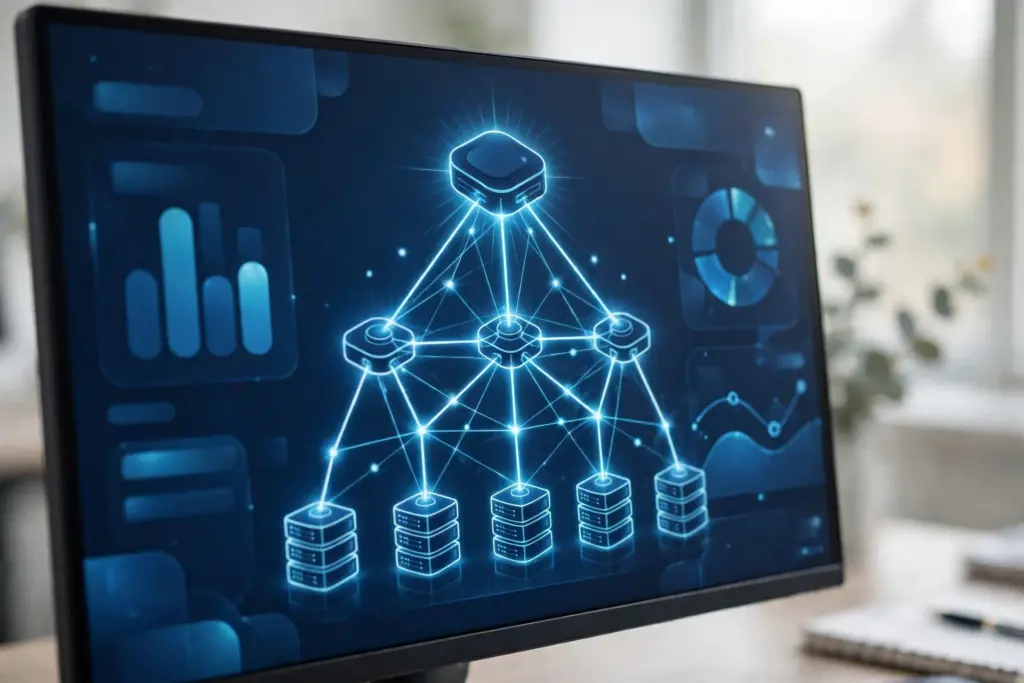
- Host — the AI application you interact with (Claude, ChatGPT, Cursor, VS Code, or an agent you build). The host coordinates everything.
- Client — a component the host creates for each server. One client holds one dedicated connection to one server; connect to four servers and the host runs four clients.
- Server — a program that exposes capabilities: your CRM, a database, a filesystem, a search engine. Servers run either locally on your machine or remotely on a vendor’s infrastructure.
Underneath, messages are JSON-RPC 2.0. Local servers communicate over stdio (standard input/output, same machine, no network). Remote servers use Streamable HTTP, which replaced the older HTTP+SSE transport in the March 2025 spec revision — the same revision that added OAuth 2.1 authorization and tool annotations marking tools as read-only or destructive. A typical call: you ask for something that needs an outside system; the client lists what its server offers; the model picks a tool; the host routes the call; the server executes it and returns the result into the conversation.


What a server offers comes in three primitives, plus one safety valve:
| Primitive | Controlled by | What it is | Example |
|---|---|---|---|
| Tools | The model invokes them (with user consent) | Executable functions | Query a database, create an issue, send a message |
| Resources | The application | Read-only data that adds context | File contents, database schemas, documents |
| Prompts | The user | Reusable interaction templates | A structured “summarize this ticket” template |
| Elicitation | The server asks, the user answers | Mid-task requests for input or confirmation | “Which workspace should I file this in?” |
MCP vs APIs, plugins, and function calling
These four get conflated constantly, and the distinction decides what you build:
- Function calling (tool use) is a feature of one model API inside one application. The app defines the functions; the model requests one; the app runs it. Nothing is reusable outside that app.
- Plugins belonged to one host product — the integration lived and died with that product.
- APIs are how software talks to software: fixed endpoints, documented by each vendor, coded against by a developer. They do not go away — nearly every MCP server is a standardized wrapper around the vendor’s API, which still does the work and enforces rate limits underneath.
- MCP is the protocol layer above all of this: a server written once can be discovered and called, at runtime, by any MCP-speaking client and model.
The economic framing, from n8n’s engineering blog: without a common protocol, connecting M AI apps to N services means maintaining up to M × N custom integrations; with one protocol, it is M + N implementations. The honest exception: for a single, fixed integration whose call sequence never changes — a nightly order sync, say — MCP adds a moving part you do not need. A direct API call is faster, deterministic, and costs no model tokens. MCP earns its place when the sequence of calls can’t be predicted in advance and an agent has to choose: a support agent that may need the order record, the shipping status, or the refund endpoint depending on what the customer says.
The business MCP servers that actually exist
Two groups. The reference servers are maintained by the MCP steering group as educational examples — the documentation itself warns they are not production-ready, so treat them as learning tools and building blocks, not finished infrastructure. The vendor servers are run by the companies whose products they expose, mostly as remote endpoints you connect to with a URL and an OAuth login.
| Server | Run by | Connect via | What the agent can do |
|---|---|---|---|
| Filesystem | MCP reference | Local (stdio) | Read/write files in directories you allow |
| Git | MCP reference | Local (stdio) | Repository operations on local code |
| Fetch | MCP reference | Local (stdio) | Retrieve and convert web pages |
| Memory | MCP reference | Local (stdio) | Persistent knowledge-graph memory across sessions |
| Time | MCP reference | Local (stdio) | Time and timezone conversion |
| GitHub | GitHub | Remote: api.githubcopilot.com/mcp/ | Repos, issues, pull requests, workflows |
| Slack | Slack | Remote: mcp.slack.com/mcp (OAuth) | Search and read channels and messages |
| Stripe | Stripe | Remote: mcp.stripe.com (OAuth) | Payments, customers, invoices, subscriptions |
| Notion | Notion | Remote: mcp.notion.com/mcp (OAuth) | Search, read, and update pages and databases |
| Atlassian | Atlassian | Remote: mcp.atlassian.com/v1/mcp | Jira issues, Confluence pages |
| HubSpot | HubSpot | Remote: mcp.hubspot.com (OAuth) | CRM contacts, deals, pipelines |
| Supabase | Supabase | Remote: mcp.supabase.com/mcp | Postgres database, auth, storage — includes a read-only mode |
| Neon | Neon | Remote: mcp.neon.tech/mcp (OAuth) | Serverless Postgres, branching, migrations |
| Exa | Exa | Remote: mcp.exa.ai/mcp | Semantic web search for research agents |
| Cloudflare | Cloudflare | Remote: mcp.cloudflare.com/mcp | Workers, KV, R2 storage, DNS |
| Playwright | Microsoft/community | Local (stdio) | Browser automation via accessibility snapshots |
A few grounding notes. Stripe’s server was labeled public preview as of September 2026. HubSpot’s documentation has given mixed signals about whether its server writes or is read-only for standard records — confirm the current scopes before you rely on write access. The original 2024 reference servers for GitHub, Google Drive, and Puppeteer have been archived: if a tutorial tells you to install @modelcontextprotocol/server-github, it is out of date — use GitHub’s own remote server instead. And Playwright matters for founders specifically: it is how agents operate web tools that have no API at all.
Where MCP fits in an automation stack
MCP does not replace your automation platform; it gives the agents inside it hands. The pattern that works in production is layered: deterministic workflow steps (fixed API calls, validations, schedules) handle everything you can specify in advance, and MCP-connected agents handle the judgment calls in between — the refund workflow where a fixed call validates the order, the agent decides whether a refund applies, and a second fixed call commits it.
In practice, workflow platforms now speak MCP in both directions. In n8n, the MCP Client Tool node attaches an external MCP server to an AI Agent node — the agent picks up the server’s tool list, you can narrow it with allow/deny tool filtering, and authentication supports bearer tokens, custom headers, or OAuth2. In the other direction, the MCP Server Trigger node exposes your n8n workflows as an MCP server (over SSE or streamable HTTP, with optional bearer auth), so a sub-workflow you built once becomes a callable tool for Claude, Cursor, or any other client. n8n also ships a built-in MCP server for managing workflows themselves. Platform catalogs work similarly — Zapier’s MCP server fronts its app catalog, and per Zapier’s documentation each successful MCP tool call consumes two tasks from your plan, a pricing detail worth knowing before an agent loops on it.
For a concrete example of an n8n pipeline that turns one recording into many assets, see our content repurposing pipeline guide. If you are still choosing a platform, see our n8n vs Make vs Zapier cost comparison.
Two cost realities to plan around. First, tool definitions are billed as tokens: OpenAI’s platform documentation notes that developers pay for the tokens used to import a connected server’s tool definitions as well as the calls themselves, so a server exposing 100 granular tools taxes every conversation before any work happens — and, as practitioners report, bloated tool lists make models indecisive and prone to calling the wrong tool. Connect the servers a task needs, expose only the tools you use. Second, every MCP call an agent makes sits inside a metered model conversation; the token economics of agent loops are covered in our breakdown of what AI agents really cost per run.
The same agent-and-tool pattern also shows up in side businesses — see our guide to AI UGC ads as a side business.
Security: the section that decides whether you should do this
Everything above is capability. This section is the price. An MCP connection is a bridge between untrusted, model-generated input and your real systems, and the attacks below are documented in security research and vendor guidance — not hypotheticals.
Tool poisoning. A malicious server can hide instructions inside its tool descriptions — text the user never sees but the model reads — steering the agent to misuse a legitimate tool. Invariant Labs documented tool poisoning attacks across providers, and Tenable researchers demonstrated poisoned descriptions hijacking model behavior to exfiltrate data.
Indirect prompt injection. Tool outputs are untrusted too. A web page, email, file, or GitHub issue the agent reads can contain text crafted to redirect it — a documented GitHub-related injection tricked assistants into leaking private repository data. Anthropic’s own Claude Code documentation carries the warning plainly: verify you trust each server before connecting it, because servers that fetch external content can expose you to prompt injection.
Rug pulls. Servers can notify clients that their tool list changed — a legitimate feature that becomes an attack when a server you approved quietly redefines a tool afterward. Pin versions, and treat any tool-definition change as a new approval decision.
Confused deputy and token passthrough. A remote server holding one shared token can end up acting for the wrong user, and a server that forwards your token downstream collapses every trust boundary — the MCP specification’s security guidance explicitly forbids token passthrough and pushes OAuth 2.1 with audience-bound tokens instead.
Over-broad permissions. A July 2025 arXiv study measuring 2,500+ real-world MCP servers found pervasive over-provisioning — servers holding far more access than their function needs. One exploit with a broad filesystem or database scope does correspondingly broad damage. Relatedly, a SQL injection flaw in Anthropic’s early SQLite reference server was forked over 5,000 times before the repository was archived in May 2025: supply-chain risk is real even in “official” code, which is one reason the reference servers carry their not-production-ready warning.
The control checklist (synthesized from the MCP specification’s security best practices and WorkOS’s MCP security guide):
- Prefer official vendor servers and the official registry; read a third-party server’s source before installing — a local server’s install command executes code on your machine.
- Least privilege everywhere: read-only modes where offered (Supabase’s, for example), a read-only database role, filesystem access limited to named directories — never your home folder.
- Require human approval for write and destructive tools; the 2026-07-28 spec requires explicit user consent for data access and operations, but enforcement lives in the host app, so verify yours actually prompts.
- Never use
@latestfor a server with write access; pin versions and re-review on updates. - Keep tokens short-lived, audience-bound, and out of logs and URLs; separate read and write scopes.
- Log every tool call, and review the logs — an agent’s actions should be as auditable as an employee’s.
A safe rollout plan for a solo founder
- Start read-only. Connect one vendor server — Slack or Notion search — in read-only fashion and use it for a week. Learn how your client surfaces tool calls and approvals.
- Add one write tool with a human in the loop. Drafting (not sending) is the right first write: an agent that prepares a GitHub issue or a Notion page for your approval.
- Move MCP into your automation platform once the pattern is familiar, so agent actions inherit your workflows’ logging, credentials management, and error handling rather than living in a chat window.
- Write down your server inventory. Every connected server, who publishes it, what scopes it holds, pinned at which version. Four lines in a doc; it is the difference between a system and a pile of experiments.
- Re-audit quarterly. Servers change, scopes creep, and new advisories land. The inventory from step 4 makes this a 30-minute job.
FAQ
Is MCP only for Claude?
No. Anthropic created it, but ChatGPT, Cursor, Gemini, Microsoft Copilot, and VS Code all support MCP, and governance moved to the Linux Foundation’s Agentic AI Foundation in December 2025, with OpenAI and Block as co-founders. A server you connect for one assistant generally works in the others.
Does MCP replace Zapier, Make, or n8n?
No — it complements them. Those platforms run deterministic, scheduled, multi-step workflows; MCP gives AI agents a standard way to discover and call tools at runtime. The platforms have moved toward MCP rather than being replaced by it: n8n can both consume MCP servers and expose workflows as one, and Zapier offers an MCP server over its catalog.
Is MCP free to use?
The protocol is open-source and free. Costs arrive indirectly: the vendor plans behind the servers (some servers need paid tiers), your automation platform’s task pricing where applicable, and the model tokens consumed by tool definitions and agent loops.
How many MCP servers should I connect?
As few as the task needs. Every connected server’s tool definitions consume context and tokens on every call, and oversized tool menus measurably degrade tool selection. Connect per-task, expose only the tools you use, and disconnect what you are not using.
Can an MCP server steal my data?
A malicious or compromised one can try — via poisoned tool descriptions, injected tool outputs, or simply the permissions you granted it. That is why the guidance is consistent across the spec and security vendors: official servers, least-privilege scopes, read-only first, human approval for writes, pinned versions, and logs you actually review.
What is the difference between a local and a remote MCP server?
Local servers run on your machine over stdio — typical for filesystem access and browser automation — and their install commands execute code locally, so vet them like software installs. Remote servers run on the vendor’s infrastructure over Streamable HTTP with OAuth, and are the safer default for business SaaS tools.
Methodology
What we did: We verified every server named in this article against current documentation, vendor pages, or maintained catalogs in October 2026, including the remote endpoints quoted in the table. Claims about the protocol’s history, architecture, and spec status come from the MCP documentation and Anthropic’s announcements as reported by the sources below; security risks and controls are drawn from the MCP security best-practices guidance and published security research and vendor guides (WorkOS’s MCP security guide, and the Invariant Labs, Tenable, and arXiv work it cites).
What we did NOT do: We did not install, penetration-test, or benchmark every server listed, and inclusion is not an endorsement of a server’s security posture — verify current scopes and status on the vendor’s own page before connecting anything to production data, because endpoints, previews, and permissions change. Adoption figures (10,000+ servers, 97M+ monthly SDK downloads) are Anthropic’s, published in its December 2025 donation announcement, and are attributed as such rather than independently audited by us.
Conflict disclosure: This article contains one affiliate link (n8n), marked in the text. No MCP server vendor, host application, or automation platform paid for placement, and no vendor reviewed this article before publication.
AWL verdict
Adopt MCP — as a standard, it has already won, and fighting it means maintaining glue code forever. But adopt it like an operator, not a tourist: official vendor servers first, read-only scopes first, human approval on every write that matters, and your existing automation platform as the place agents live. The founders who get hurt by MCP in 2026 will not be the ones who moved slowly; they will be the ones who installed a dozen community servers with broad tokens because a demo looked fast. For a solo founder, our micro-SaaS stack guide covers the wider stack this fits into.
Sources
- Pandromeda — MCP explained: history, governance, architecture, adoption figures (verified October 2026) — https://pandromeda.com/software/what-is-mcp-model-context-protocol-a-plain-english-guide
- Latenode — What is MCP: spec revisions, reference servers, vendor server details (verified October 2026) — https://latenode.com/blog/what-is-mcp-model-context-protocol
- n8n — MCP vs API: integration model, MCP Client Tool and MCP Server Trigger nodes (verified October 2026) — https://blog.n8n.io/mcp-vs-api/
- WorkOS — The complete guide to MCP security: risks and best practices (verified October 2026) — https://workos.com/blog/mcp-security-risks-best-practices
- MCP Playground — Awesome MCP servers catalog: remote endpoints for GitHub, Slack, Stripe, Notion, Atlassian, HubSpot, Supabase, Neon, Exa, Cloudflare (verified October 2026) — https://mcpplaygroundonline.com/blog/awesome-mcp-servers